
Zeta Industrial Electrode Steam Boiler with Immersed Electrode Technology
Zeta’s industrial electric boilers with immersed electrode technology – designed by Zander & Ingeström (Zeta) – delivers unmatched robustness and performance for high-pressure steam electric boiler application. This proven immersion boiler design ensures outstanding thermal efficiency while eliminating greenhouse gas (GHG) emissions, making it ideal for industrial decarbonization projects.
How an Immersed Electrode Boiler Works
An electrode boiler has no heating element and no burner. The water itself carries the current: the electrodes are immersed directly in the boiler water, and the natural resistance of that water turns electrical energy into heat. Because the water is the resistor, nothing stands between the energy and the steam, which is why an electrode steam boiler reaches a thermal efficiency of up to 99.8 %.
Output is controlled by varying how much electrode surface is in contact with the water, which gives smooth modulation from 5 % to 100 % of capacity without cycling. In an immersed design the water stays calm around the electrodes, unlike a jet design where water is sprayed at them. The consequences for wear, stability and steam quality are set out further down this page.
Zeta Electrode Steam Boiler: Technical Specifications
- Steam output : 5 MW to 70 MW (17 000 lb/h to 245 000 lb/h)
- Steam pressure : 7 barg to 66 barg (100 psig to 950 psig)
- Available voltages: High voltage boiler at 13.8 kV, also available in MV (4.16 kV, 6.9 kV)
- Thermal efficiency: Up to 99.8%
- Modulation range : 5%–100%
- Electrode type: Immersed
- Certifications : ASME, CSA, CRN, ISO 9001, ISO 14001, ISO 45001
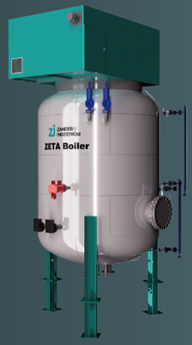
These specifications make Zeta a top choice among high voltage boiler and industrial electric steam boiler solutions.
Who Manufactures the Zeta Electrode Steam Boiler
- Inventor of the immersion boiler in 1926 (patented in 1936)
- Nearly a century of innovation in electrode boiler design.
- Over 3,000 industrial electric boiler installations worldwide
- Manufactured in Canada with North American components Supported locally by trained Quebec-based technicians
Features of the Industrial Electrode Boiler
- Zeta’s industrial electric boilers are built for flexibility and reliability:
- Compact footprint, ideal for limited boiler room space
- Fast and easy installation, minimal commissioning time
- Instant response to steam demand with full-range modulation
- They operate in tandem with fuel-fired boilers to manage electrical peak loads.
- The boiler is controlled by a PLC and can be easily integrated into DCS systems.
Downloads
Zeta Electrode Boiler Brochure (PDF)
General Arrangement Drawings – Zeta Electrode Boiler (PDF)
Operation & Maintenance Manual – Zeta Electrode Boiler (PDF)
Technical Specifications – Zeta Electrode Boiler (Word)
Immersion vs Jet Electrode Boiler
When compared to jet boiler models, Zeta’s immersion boiler offers superior performance, reliability, and safety
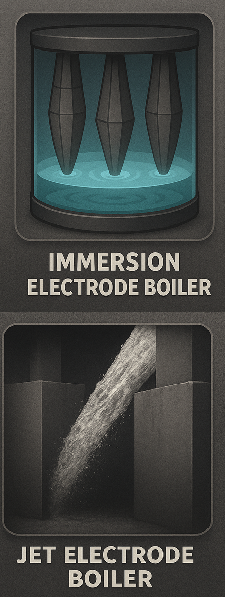
Increased Durability
- Less erosion and wear on the electrodes due to the absence of mechanical impact: water remains calm around the immersed electrodes, ensuring a minimum lifespan of 5 years with a replacement horizon of 10 years.
Stability and Safety
- Better stability without arcing issues, reducing the risk of costly production shutdowns.
- Does not generate electrolysis, thus avoiding dangerous risks of hydrogen accumulation and increased corrosion caused by oxygen.
- Erosion of components in the jet type boiler causes uneven water jets between phases, leading to load imbalances and high leakage current. This jet boiler requires the use of a special transformer with grounding (4 wires).
- Fewer phase imbalances thanks to a high internal resistance (3000 Ohms), resulting in a very low leakage current — eliminating the need for a transformer with grounding, a costly and essential component required with jet boilers.
Steam Quality and Mechanical Simplicity
- Better steam quality, with less carryover of water, improving efficiency compared to jet boilers and reducing wear on downstream components.
- Mechanical simplicity with fewer moving parts. The recirculation pump circulates a very small volume of water. In contrast, jet boilers require a much higher flow rate, putting more stress on mechanical components. This key design difference translates into increased reliability and durability for your industrial electric boiler system compared to traditional jet boiler models.
Compared to other industrial electric steam boiler technologies, the Zeta immersion boiler reduces maintenance, improves steam quality, and enhances overall system stability.
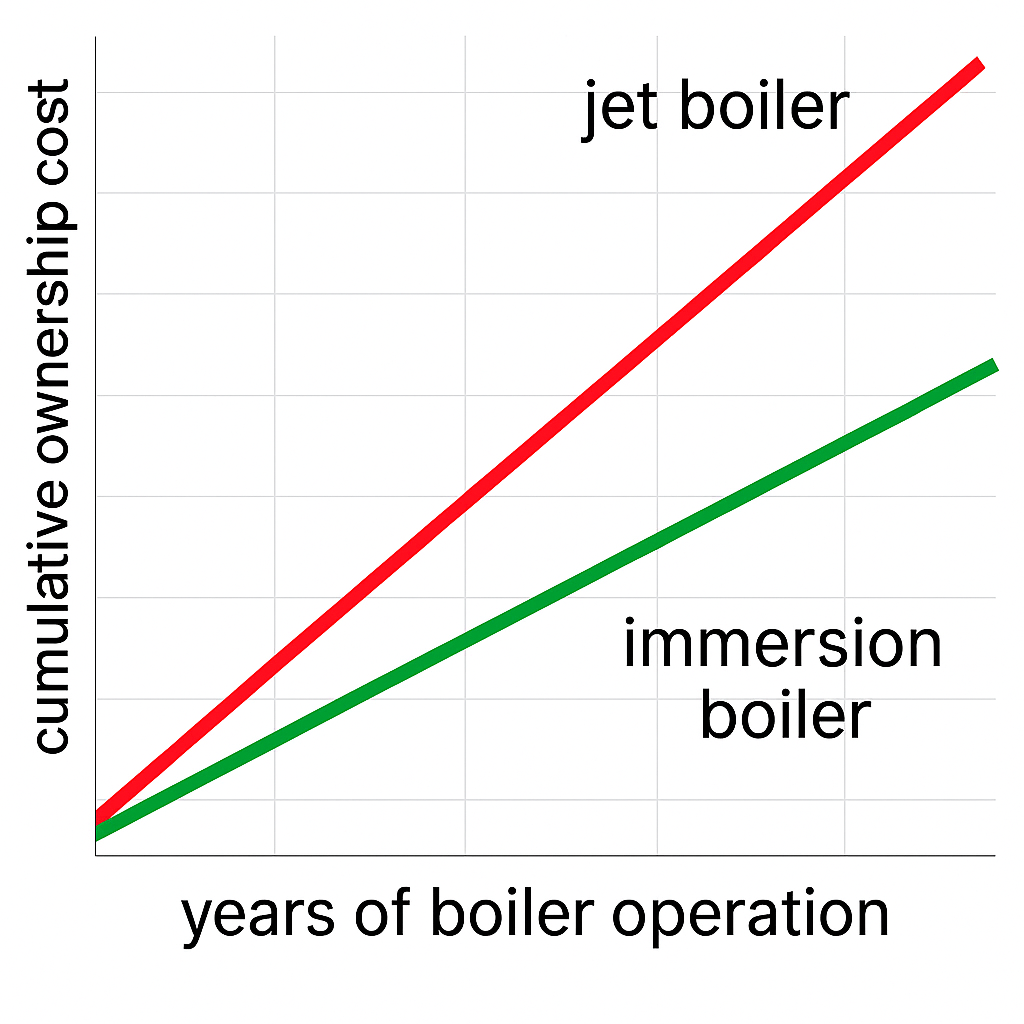
Lowest Total Cost of Ownership
- Simpler and less expensive technology to acquire and operate
- Superior reliability and reduced maintenance costs
- Easy installation and startup: does not require make-up air or a chimney
- Up to 12 MW (42,000 lb/h), suitable for periodic attendance
- Reduced blowdown losses due to lower water conductivity Combined with local support and quick access to parts, this makes it the most cost-effective electric steam boiler solution on the market.
Industrial Decarbonization with an Electrode Steam Boiler
- Allows for the elimination of up to 1,000 tons of GHGs per year for each electric MW versus an equivalent fuel-fired boiler
- Subsidies available for decarbonization can cover up to 75% of the total project cost
- Control module enables load shedding to minimize costs during peak periods and to manage Hydro-Québec’s GDP events
- Support from our engineers during the subsidy application process to maximize available financial assistance
Installing a Zeta industrial electric boiler as part of your energy transition reduces emissions and gives access to major financial incentives, while also future-proofing your operation with a scalable high voltage boiler solution.
Frequently Asked Questions
What is an electrode in a boiler?
The electrodes are the conductors that bring the supply voltage into the water. Current flows between them through the boiler water itself, and the water’s own electrical resistance releases the heat. There is no heating element and no flame: the water is both the resistor and the medium being heated.
What is electrode heating?
Electrode heating converts electricity into heat directly inside the fluid being heated, using the fluid’s own resistance rather than a metal element. Applied to a steam boiler it means a thermal efficiency of up to 99.8 %, no combustion, no flue gas and no on-site greenhouse gas emissions.
How long do boiler electrodes last?
In the Zeta immersed design the water stays calm around the electrodes, so there is no mechanical impact and erosion stays limited. Expect a minimum service life of five years, with a replacement horizon of about ten years. A jet design, where water is sprayed onto the electrodes, wears them faster.
What is the difference between an immersion electrode boiler and a jet electrode boiler?
An immersion boiler holds the electrodes in still water; a jet boiler sprays water onto them. The immersed design avoids arcing, does not generate electrolysis and therefore avoids hydrogen accumulation, and carries a high internal resistance of about 3,000 ohms that keeps leakage current very low, which removes the need for the grounded transformer a jet boiler requires. It also carries less water over into the steam.